It's been almost a year since my last post and a lot has changed. It became impossible to continue with the course while living in Indonesia as we had to start preparing to leave the country and move to Toronto.
Now that we are safely installed in our new house, I can now take up where I left off and continue with my journey into photography.
There is a lot of snow on the ground here at the moment so hopefully I'll be able to get some good subjects for the assignments.
Tuesday, January 25, 2011

Friday, March 26, 2010
Project: Balance
It's been a couple of months since my last entry - a few family problems to deal with. Hopefully now I can pick up and get on with the course.
Balance has proved to be more complicated than I originally thought it would. I have been looking back through the pictures that "work" for me over the last few years, and have found it difficult to pick out the balance in many of the pictures even though they are some of my favourite photos.
While I originally made choices about whcih photos to use for this assignment, I kept finding myself re-examining them over and over. This was because I was trying to decide whether I was choosing these pictures because they were balanced, or because of the frame position, because of the Rule of Thirds for example.
The photos that I picked are included below.

This photo balances in two ways -firstly the symmetrical aspect of the picture and also with the central location of the colour surrounded by the white of the petals.

I feel that this photo balances well as it has three distinct areas and the groups of zebra balance across the image. There is also distinct areas of contrast between the lake and the foreground.

In this image, the balance is achieved with the bright sunlit leaves on the tree and the shaded areas in the bottom portion of the picture. Using the "Weighing Scale" interpretation would have two equal weights equidistant from the middle of the scale.

This picture is similar to the Orchid picture above. It is symmetrical around the elephant.


I feel that these pictures are balanced, but some are also examples of the Rule of Thirds and implied triangles, both of which help to make a photo "pleasing" to look at.
Balance is definitely something that needs to be looked at during the coming assigments and I will be continuing to look at how my photos balance to aid the way that I look at potential subjects.
Balance has proved to be more complicated than I originally thought it would. I have been looking back through the pictures that "work" for me over the last few years, and have found it difficult to pick out the balance in many of the pictures even though they are some of my favourite photos.
While I originally made choices about whcih photos to use for this assignment, I kept finding myself re-examining them over and over. This was because I was trying to decide whether I was choosing these pictures because they were balanced, or because of the frame position, because of the Rule of Thirds for example.
The photos that I picked are included below.
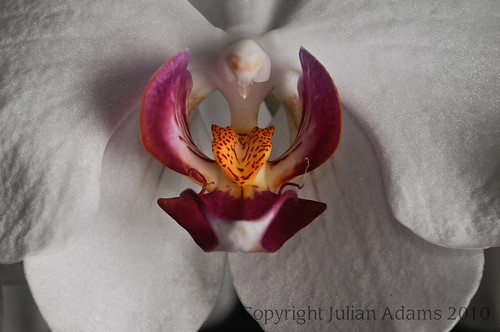
This photo balances in two ways -firstly the symmetrical aspect of the picture and also with the central location of the colour surrounded by the white of the petals.
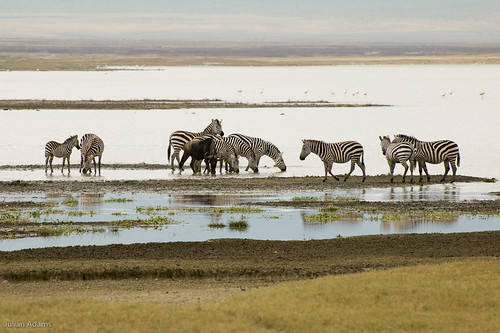
I feel that this photo balances well as it has three distinct areas and the groups of zebra balance across the image. There is also distinct areas of contrast between the lake and the foreground.

In this image, the balance is achieved with the bright sunlit leaves on the tree and the shaded areas in the bottom portion of the picture. Using the "Weighing Scale" interpretation would have two equal weights equidistant from the middle of the scale.
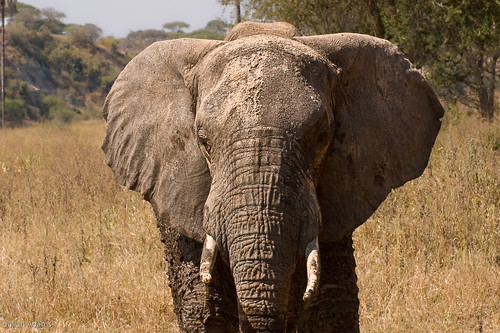
This picture is similar to the Orchid picture above. It is symmetrical around the elephant.

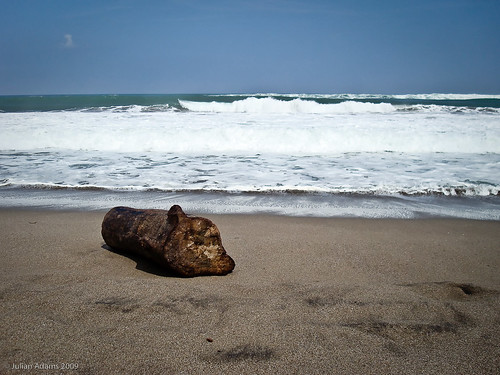
I feel that these pictures are balanced, but some are also examples of the Rule of Thirds and implied triangles, both of which help to make a photo "pleasing" to look at.
Balance is definitely something that needs to be looked at during the coming assigments and I will be continuing to look at how my photos balance to aid the way that I look at potential subjects.
Monday, January 18, 2010
Photography Sites of the Week - Daily Telegraph
One of the ways that we can learn in photography is through looking at other photographers work, be it at exhibitions, through the magic of the internet, or through books.
Living in Jakarta, there aren't that many galleries so the internet and books are my main sources. I have recently discovered that The Daily Telegraph has a page called Photography Sites of the Week.
http://www.telegraph.co.uk/culture/photography/6515582/Photography-sites-of-the-week.html
This page is dedicated to finding "..interesting, inspiring or amusing sites and stories related to photography." I've just started looking at the sites as it goes back to November 9th 2009 so there are quite a few to look at.
This week it is dominated of course to the Haiti earthquake and its awful aftermath. The pictures say more than any of the news reports could ever do - as they say a picture is worth a thousand words.
My hat goes off to those photographers working in disaster areas or war torn countries.
Living in Jakarta, there aren't that many galleries so the internet and books are my main sources. I have recently discovered that The Daily Telegraph has a page called Photography Sites of the Week.
http://www.telegraph.co.uk/culture/photography/6515582/Photography-sites-of-the-week.html
This page is dedicated to finding "..interesting, inspiring or amusing sites and stories related to photography." I've just started looking at the sites as it goes back to November 9th 2009 so there are quite a few to look at.
This week it is dominated of course to the Haiti earthquake and its awful aftermath. The pictures say more than any of the news reports could ever do - as they say a picture is worth a thousand words.
My hat goes off to those photographers working in disaster areas or war torn countries.
Thursday, January 14, 2010
It's been a bit slow...
I have to admit, that over the last couple of weeks I've been struggling to get on with the course. I'm due to be submitting my first project to my tutor in the next week or so, having delayed it already.
I'm hoping that now the new year is here that I can get stuck in to everything again.
On the recommendation of another student I invested in The Genius of Photography by Gerry Badger so will be tucking into that over the coming weeks.
My wife also bought me "In Focus - National Geographics Greatest Portraits" for Christmas which is full of amazing pictures and comments from some of the best Nat Geo photographers, so that will be another source of inspiration.
I think that the biggest inspiration I get is from other people telling me that they like my photos - that is what gets me to carry on, so long may it continue!!!!
I'm hoping that now the new year is here that I can get stuck in to everything again.
On the recommendation of another student I invested in The Genius of Photography by Gerry Badger so will be tucking into that over the coming weeks.
My wife also bought me "In Focus - National Geographics Greatest Portraits" for Christmas which is full of amazing pictures and comments from some of the best Nat Geo photographers, so that will be another source of inspiration.
I think that the biggest inspiration I get is from other people telling me that they like my photos - that is what gets me to carry on, so long may it continue!!!!
Exercise: A sequence of composition
For the latest exercise we had to find somewhere with lots of people. Whilst on holiday over Christmas, we visited Candi Prambanan which is a large Hindu temple in south central Java. It was full of tourists, both foreign and domestic, so definitely fitted the profile of the exercise.
Even being surrounded by lots of people who weren't looking at me, I felt very self conscious as I was sure that everyone would notice that I wasn't pointing my camera at the other tourists rather than the temple.
However I got on with it and in the end realised that I was as invisible as everyone else.
I looked around for stories in the crowd and found various families walking around with children that looked very bored, and they made some interesting subjects, but I felt uncomfortable shooting them, and I won't be posting the pictures from those series, but I do have them for my records.
Eventually, I did realise that there was a story going on there. There was a man there selling information leaflets about the temple, and he looked lost inside this sea of people. I originally noticed him during one of my wide angle shots of the area, talking to a young lady with her child. Centering on him I moced closer and zoomed in. However I was in the wrong position to get any close up shots, as the general movement of people was coming towards me, so I decided to move to the other side of the temple. This not only put me in position so that he was facing me, but also gave me a bit of cover to shoot from.
The change in position worked well as I was able to get some shots of him looking a little lost in the crowd. Eventually he was approached by a family who wanted to buy the leaflets and I was able to get a shopt of the transaction actually taking place. The pictures show that the temple, whilst an interesting place to visit is also the way that some of the local people earn their living and are able to support their families.


Even being surrounded by lots of people who weren't looking at me, I felt very self conscious as I was sure that everyone would notice that I wasn't pointing my camera at the other tourists rather than the temple.
However I got on with it and in the end realised that I was as invisible as everyone else.
I looked around for stories in the crowd and found various families walking around with children that looked very bored, and they made some interesting subjects, but I felt uncomfortable shooting them, and I won't be posting the pictures from those series, but I do have them for my records.
Eventually, I did realise that there was a story going on there. There was a man there selling information leaflets about the temple, and he looked lost inside this sea of people. I originally noticed him during one of my wide angle shots of the area, talking to a young lady with her child. Centering on him I moced closer and zoomed in. However I was in the wrong position to get any close up shots, as the general movement of people was coming towards me, so I decided to move to the other side of the temple. This not only put me in position so that he was facing me, but also gave me a bit of cover to shoot from.
The change in position worked well as I was able to get some shots of him looking a little lost in the crowd. Eventually he was approached by a family who wanted to buy the leaflets and I was able to get a shopt of the transaction actually taking place. The pictures show that the temple, whilst an interesting place to visit is also the way that some of the local people earn their living and are able to support their families.


Thursday, December 17, 2009
Object in different positions in the frame
In this exercise the requirement was to find a subject that is clear and set within a large even background.
Living in the middle of Jakarta does not really five me very good options for this so I had to manufacture my subject and so I used some of the flowers from the garden.


Picture 2: In this one, I moved it slightly off centre. Here there is now a question that the viewer can ask. Why is the subject not in the centre?

Picture 3: Here I decided to try moving it off centre in a different direction to see if it created a different feeling than Pic 2. Personally, I feel that it doesn't change the relationship with the background.

Picture 4: This is my preferred positioning. The photo feels balanced even though there is a large area of empty space. I have used this positioning before when cropping one of my images from safari in Tanzania in 2007.

Living in the middle of Jakarta does not really five me very good options for this so I had to manufacture my subject and so I used some of the flowers from the garden.

Picture 1: This image certainly puts the subject right in your line of sight. However as this is not a picture detailing symmetry or patterns, it seems that it is a little boring, and doesn't require the viewer to do anything. It is easy to look quickly and dismiss it.

Picture 2: In this one, I moved it slightly off centre. Here there is now a question that the viewer can ask. Why is the subject not in the centre?

Picture 3: Here I decided to try moving it off centre in a different direction to see if it created a different feeling than Pic 2. Personally, I feel that it doesn't change the relationship with the background.

Picture 4: This is my preferred positioning. The photo feels balanced even though there is a large area of empty space. I have used this positioning before when cropping one of my images from safari in Tanzania in 2007.

Little Bee Eater - Tanzania 2007
Copyright Julian Adams
Thursday, December 3, 2009
Exercise: Fitting the frame to the subject
The first exercise for "Part 1: The Frame" is about fitting the frame to the subject.
For me it is an introduction to the need for thinking about composition.
As a subject I decided to use the bizarre statue in our garden - it belongs to the landlady, and as you can see it is a statue of two frogs hugging!.

For the first image, I just walked up to it and took the photo. The statue is positioned in the middle of the image, and the angle is looking down on it which makes it look small and unrealistic.
This shot reminds me of how most holiday photos are taken - no consideration to the subject. You don't really get a sense of the size of the statue and with its central positioning there is nothing really to draw in the audience.

I tried various angles and views to try and make this fit better in the frame. Due to its shape I could only put it on the top and bottom edges of the frame leaving a fair amount of space around the statue.

With this subject I think that the close up picture is the best, although this isn't the point of this exercise. the lichens growing on the statue give a lot of details and contrast that you don't really see when looking at the last image.

This image gives a better idea of the positioning of the staute in the garden, with a much better viewing angle than the first picture in this series. However I feel that the cropped image below is better. There is much better balance, and more depth to the image.

For me it is an introduction to the need for thinking about composition.
As a subject I decided to use the bizarre statue in our garden - it belongs to the landlady, and as you can see it is a statue of two frogs hugging!.

This shot reminds me of how most holiday photos are taken - no consideration to the subject. You don't really get a sense of the size of the statue and with its central positioning there is nothing really to draw in the audience.

I tried various angles and views to try and make this fit better in the frame. Due to its shape I could only put it on the top and bottom edges of the frame leaving a fair amount of space around the statue.

With this subject I think that the close up picture is the best, although this isn't the point of this exercise. the lichens growing on the statue give a lot of details and contrast that you don't really see when looking at the last image.

This image gives a better idea of the positioning of the staute in the garden, with a much better viewing angle than the first picture in this series. However I feel that the cropped image below is better. There is much better balance, and more depth to the image.

Subscribe to:
Posts (Atom)